
Training through menopause
You're doing everything right. Your body stopped agreeing.
6 min read · Reviewed by Maria Vazquez, Head of Training, NASM Certified Personal Trainer
Here is a specific kind of frustration that almost nobody warns you about.
You are not one of the women who let it go. You kept moving. Maybe you ran, or swam, or took the class three mornings a week for fifteen years. You know what effort feels like and you have been putting it in.
Then somewhere around 46, or 49, or 52, the arithmetic broke. Same work, different result. The weight settled somewhere it never used to. Recovery started taking two days where it used to take one. A shoulder that never once complained began complaining.
And the advice you get, when you finally go looking, is to try harder or eat less.
You already know that isn't it.
The thing nobody sends you
There's a post that circulates in menopause communities, written by a woman who had done CrossFit for years, discovering only then that hammering high-intensity sessions might not be the right lever anymore. The title is a single exasperated question: why did nobody tell her that the way you train is supposed to change?
That question is the whole problem in one line.
Not "what should I do." Not "how do I get motivated." Something more specific and more maddening: the rules changed underneath you, quietly, and nobody handed you the update. You have been following instructions written for a body you no longer have, then treating the poor results as evidence about your character.
What actually changed
Three things move at once, which is part of why it feels so disorienting.
Recovery gets slower and the margin gets thinner. Declining estrogen affects connective tissue, and joint pain turns out to be one of the more common complaints of this stage rather than a coincidence or a personal failing. Women describe it the same way over and over: the loading that felt fine at 44 is producing a cranky hip or an inflamed tendon at 53. Nothing about the exercise changed. The tissue doing it did.
The body composition response shifts. Muscle is harder to keep and easier to lose. Bone density becomes a live concern rather than an abstract one. And the high-intensity cardio many women leaned on for two decades may no longer be the most efficient tool for the outcome they actually want, which is a genuinely counterintuitive thing to be told after twenty years of it working.
Sleep and cognition get in the way of the logistics. This one gets underrated. You wake at three and stay awake. Then you cannot hold the program in your head. One woman described exactly this: she trained well with a person, then found she could not remember any of the movements once they weren't there, and named the reason as brain fog. Planning a session ends up costing more energy than doing one, and the skipped week starts there rather than in any lack of will.
Why the advice you find makes it worse
Go looking for what to do about this and you hit something genuinely difficult. The advice contradicts itself, and not at the fringes. At the center.
Search any menopause fitness thread and you will find an expert-backed argument that this stage specifically demands heavy loading, four to six reps, heavier than anything you have touched before. Directly underneath, you will find an equally confident argument that nothing about training in perimenopause is different at all and the standard principles apply exactly as they always did. Both come with citations. Both come from people who know a great deal.
You cannot resolve that from your kitchen table. Adjudicating between competing exercise physiologists is not a reasonable thing to expect of someone who just wants to know whether to pick up the 8kg or the 15kg on a Tuesday morning.
One woman in that exact thread put the situation perfectly while trying to help someone else. She said she couldn't recommend an instructor, because she was still trying to work it out herself.
That is the state of the information. Loud, contradictory, and unable to tell you which half applies to your joints, your history, and this particular week.
The second gap: nobody can see you
Even when the plan is right, there is a problem no plan solves.
A video shows you what the movement looks like. It cannot see that your knee is tracking inward, that your ribs flare at the top, that you're compensating through one hip because the other one is guarding. Those errors don't announce themselves. They accumulate quietly for months and then present as an injury.
The gap between knowing what an exercise looks like and knowing you're doing it correctly is where most solo training quietly fails. At a stage when connective tissue is more vulnerable and a setback costs months instead of days, that gap gets expensive.
Women who close it describe the change in almost identical terms. One wrote that a single hour with a trainer taught her more about form and technique than everything she'd pieced together alone. Another put it more bluntly, calling her trainer the key piece in the puzzle of getting through this stage.
What actually works at this stage
Strip it down and three things do the work.
Not a template, and not a generic protocol adapted after the fact. Load, volume, and recovery planned around your joints, your history, your energy, and where you actually are hormonally.
Correction in the moment the error happens, not six months later in a physio's office. This is what makes progressive loading safe rather than a gamble.
Somebody who holds the plan so you don't have to hold it through the brain fog, who scales the session when you slept badly rather than letting you cancel it, and who gets you back on track after the week you disappeared.
What that looks like at Mywowfit
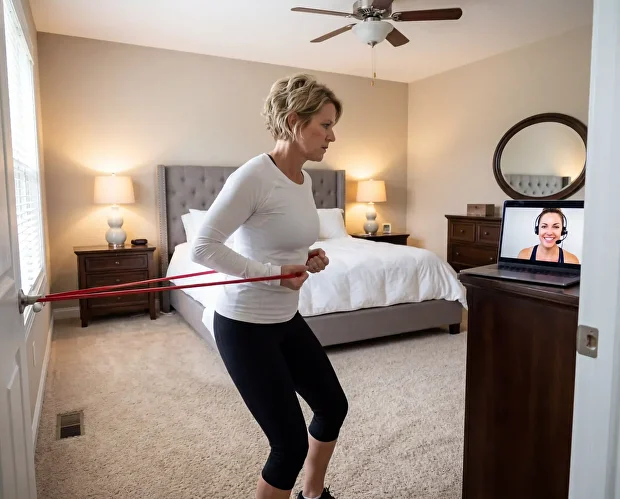
Sessions are 1-on-1 over Zoom, from your living room, with a trainer matched to this specific stage. For clients in peri- and post-menopause, that means someone with correctional qualifications and real experience programming around joint health, bone density, and recovery that moves week to week.
They watch you move. They know your history. When you show up flattened after four hours of sleep, the session changes shape instead of getting cancelled, which over a year is the entire difference between progress and another restart.
Julia, 49, describes the shift as learning to train for her hormones rather than against them, and coming out stronger and more in control of what was happening to her.
Sheila, 54, came in nervous about training again with joint pain and hot flashes in the picture, and found the thing she needed was someone showing her how to load safely without burning herself out.
Neither of them needed more information. They needed someone applying the right information to their particular body, in real time.
"Do I have to lift heavy? I don't want to hurt myself."
You need to load your muscles and bones meaningfully. What "meaningfully" means for you depends on your joints, your training history, and where you are right now, which is exactly the question the internet cannot answer and a trainer can.
Heavy is relative and it is built toward, not jumped into. The trainer's job is to find your actual starting point, then move it. Not to hand you someone else's number.
What starting actually involves
You have already done the reading. What you have been missing is somebody who can tell you which parts of it are yours.
Here's what the first step looks like.
HOW MYWOWFIT WORKS — TRAINING BUILT AROUND YOUR HORMONAL REALITY
GET MATCHED & START BUILDING. FROM THE COMFORT OF YOUR HOME
MEET OUR COACHES WHO SPECIALIZE IN HORMONE-AWARE TRAINING
Vanessa
Shashi
Lina
Fernanda
YOUR GOALS, YOUR PACE — SUPPORTED EVERY STEP OF THE WAY
CLIENT STORIES — HOW WOMEN FEEL STRONGER THAN EVER
















Pricing for menopause Training



Train With Pleasure At Your Own Pace, Just Like Thousands Of Our Clients Do
Have a special medical condition? Book a consultation with Maria
Start with consultation— THEN TRAIN WITH A COACH WHO UNDERSTANDS YOUR HORMONES
You may also be interested
Meet some of our trainers
Responses (3)

All rights reserved


How it Works
Trainers
Pricing
Blog
FAQ
Gift Certificate
Referral Program
Work with Us
Affiliate Program
Terms of Service
Code of Conduct
Disclaimer of Medical Advice
Cancellation, Refund, Referral Policy
Services


USA, 1111B S Governors Ave #6047 Dover, DE 19904, Online Fitness Technologies INC
EU and UK: MYWOWFIT OU, Estonia, Harju maakond, Tallinn, Kesklinna linnaosa, Tornimäe tn 3 // 5 // 7, 10145





Share via