
Fitness after 50
The reason you keep starting over at 55, and it isn't willpower
6 min read · Reviewed by Maria Vazquez, Head of Training, NASM Certified Personal Trainer
There's a moment most people over 50 can name exactly.
You bend down to pick something up off the floor. Getting down is fine. Getting back up takes a small negotiation: one hand on the coffee table, a pause, a sound you didn't used to make.
Nothing is wrong. Nothing hurts enough to call a doctor about. You've just noticed something you can't un-notice.
For most people, that moment starts a familiar sequence. You decide this is it. You find a program. You do four days of it, or eleven, or three weeks if the January energy is strong. Then a work trip, a sore shoulder, a run of bad sleep, and it quietly ends. Six months later you're back at the same coffee table having the same thought, feeling slightly worse about yourself than last time.
Run that loop three or four times and you start to conclude the problem is you.
It's worth knowing that it almost certainly isn't.
You've been solving the wrong problem
Ask people over 50 what stopped them and they rarely say they didn't know what to do. They say some version of: I knew, I just couldn't keep going.
That's worth sitting with, because it means more information was never going to fix it. You've watched the videos. You know strength training matters at this age. You've read about protein, bone density, muscle loss. The knowledge isn't missing.
What's missing is structure. Everything you tried put the entire weight of showing up on one unreliable input: how you feel that particular morning.
Look at what actually failed, and why.
YouTube workouts. Free, endless, and completely indifferent to whether you press play. Nobody notices when you stop. Nobody sees your knee caving inward on the twelfth rep.
The gym membership. You paid in advance, months ago. By March the money is already spent and skipping today costs you nothing. The building is full of people who look like they were born knowing where everything is.
Apps. They send notifications. Notifications are easy to swipe away. An app can't tell that you slept badly and should train differently today rather than not at all.
Group classes. One program, twelve bodies, one pace. Modify nothing, ask nothing, hope your shoulder holds.
Walking. Genuinely good for you. Also not enough on its own to hold onto muscle and bone in your fifties and sixties.
Two things changed, and nobody handed you the new rules
The first is recovery. At 35, a bad session cost you two sore days. Now a strain can cost you three months, and those three months don't just pause your progress. They reset the whole attempt, because by the time your back is fine you've lost the habit, the confidence, and any belief that this time was different.
That's why "just push through it" is bad advice at this age, and why the fear of getting hurt is doing more damage than the missed workouts. Caution keeps you on the couch, and the couch is what's actually costing you.
The second change, for women in particular, is that the old methods stopped working on their own terms. Women who taught Pilates for twenty years describe hitting menopause and watching a body that had always responded simply stop responding. Same effort, different result. Nothing about that is a discipline problem.
Almost every free program you can find was built for a younger body with stable hormones and a fast recovery window. Following it now means working from the wrong manual, then blaming yourself when the numbers don't move.
What actually predicts whether someone is still training a year later
Two things, and neither one is motivation.
Not an app. A person, at a set time, who notices your absence. People who've broken the start-stop cycle almost always describe the same mechanism in their own words: someone was waiting, and the money was already committed, and that was enough to get them out the door on the mornings when nothing else would have.
It sounds too simple to be the answer. It's the answer. Motivation is a mood, and moods don't hold a schedule together. An appointment does.
Live, in the rep where the mistake happens. Not a video demonstrating what good form looks like while you guess whether yours matches. A person who sees the knee drift, the back round, the shoulder shrug up, and stops you before it becomes the injury that costs you the next three months.
People who spent years getting hurt over and over describe the change the same way. They finally worked with someone who watched them and taught them form, and the injuries stopped.
What that looks like in practice
Mywowfit was built around those two things and not much else.
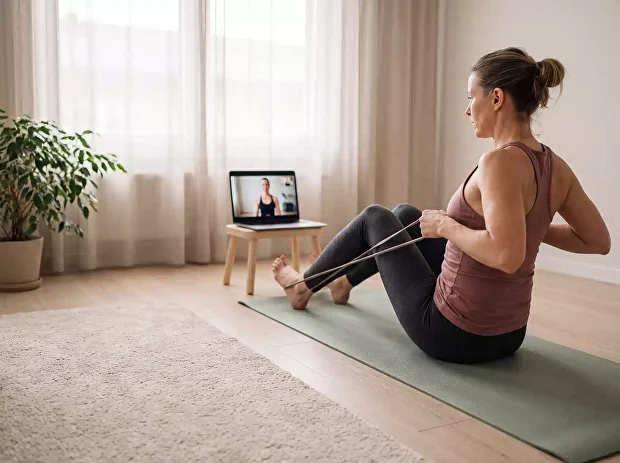
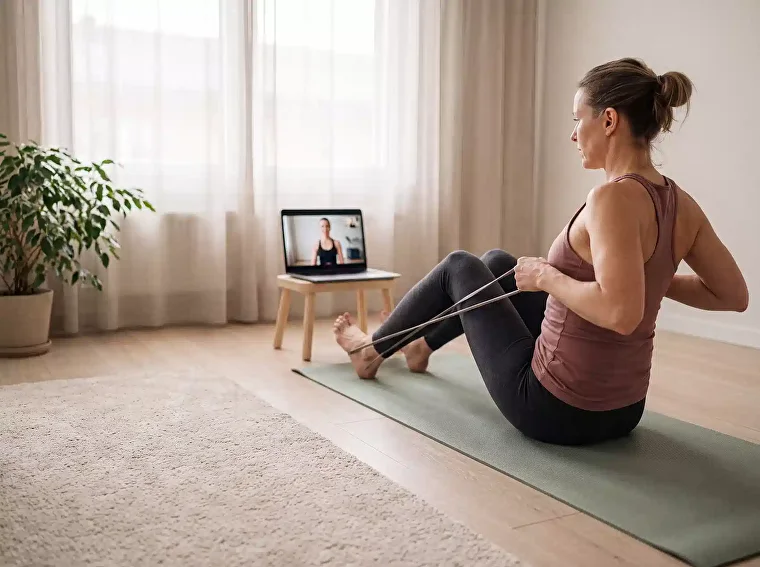
Sessions are 1-on-1 over Zoom, from your living room, with a certified trainer who knows your history: the knee, the surgery, the blood pressure, the weeks your energy disappears. They watch you move and correct you in real time. When today is a bad day, the session changes shape instead of getting skipped.
Nadene started at 58, after ten years of telling herself she'd get back to it eventually. Her description of what changed is unglamorous: someone was waiting for her on Tuesday morning, her trainer watched her move and told her exactly what to do, and she just had to show up. Eighteen months later she was stronger than she'd been at 40, with no injuries along the way.
That pattern repeats often enough across the 728+ reviews to be the actual product rather than a nice story.
"Can a trainer really see enough over a video call?"
Fair question, and the honest answer is that it depends what you're doing. For maximal barbell work with a loaded bar over your chest, you want someone physically there.
For the training that rebuilds strength, balance, and mobility after 50, a trainer on screen catches exactly what they'd catch standing beside you: the knee drifting in, the spine rounding, the weight shifting to one side. They stop the rep and fix it. The camera doesn't weaken that.
What the camera adds is the removal of every reason you skipped before. No drive. No parking. No locker room. No walking past people half your age while you figure out which machine is which. You roll out of bed and you're there, which turns out to matter more than anyone expects.
"Isn't it too late?"
The research on this is unusually clear, and it points the other way. Adults in their seventies and eighties build measurable muscle when they train properly. The window doesn't close at 50, or 60, or 70.
What does happen is that the cost of waiting gets steeper. Muscle you don't use now is harder to rebuild in five years than it is this month. The people who wish they'd started earlier are always describing a decision they made a decade ago, never one they made today.
You don't need to be in shape to start. Starting is what gets you in shape, and a trainer who works with beginners over 50 every day has seen people arrive in far worse condition than you're imagining for yourself.
What starting actually involves
The version of you a year from now is being decided by what happens in the next two weeks, not by how much more you read about it. You've done the reading.
Here's what the first step looks like.
HOW MYWOWFIT WORKS — TRAINING THAT ACTUALLY STARTS, AND ACTUALLY STICKS
✔ Clear guidance and coaching in real time (what to do + how to do it safely)
✔ Exercises adapted to your fitness level, mobility, and any pain or past injuries
✔ Progress you can feel: strength, balance, flexibility, and confidence week by week
Train from home
Meet Some Of Our Trainers


Weight Loss, Anxiety, Depression, Knee & Back Pain, Peri/Menopause, Sciatica, Strength +10 more
Injury Recovery, Arthritis, Diabetes, High Blood Pressure, Menopause, Fatigue, Bone & Joint Health, Weight Loss +10 more
Chronic Pain, Osteoporosis, Cardiovascular Disease, Post-Surgery Rehab, Menopause, Back Pain, Depression +10 more
Physical Therapy, Wheelchair, Postural Correction, Muscular Dystrophy +15 more


Have a special medical condition? Book a call with Maria
What Our Clients Say
I have been training with Natasha Felix for 2 months. I am 62 years old. I have knee issues and Natasha is assisting with strength and conditioning exercises She explains and demonstrates all the exercises she does with me. I see her twice a week and really enjoy the routine and exercises.















Choose Your Pay-As-You-Go Plan
an assesment


You may also be interested
Meet some of our trainers
Responses (3)

All rights reserved


How it Works
Trainers
Pricing
Blog
FAQ
Gift Certificate
Referral Program
Work with Us
Affiliate Program
Terms of Service
Code of Conduct
Disclaimer of Medical Advice
Cancellation, Refund, Referral Policy


USA, 1111B S Governors Ave #6047 Dover, DE 19904, Online Fitness Technologies INC
EU and UK: MYWOWFIT OU, Estonia, Harju maakond, Tallinn, Kesklinna linnaosa, Tornimäe tn 3 // 5 // 7, 10145





Share via