
10 Best Workout Splits: Complete Guide to Training Split Routines
Last updated: 18/05/2026
Author: Zoe Patler
Medically reviewed by Maria Vasquez, NASM Certified Personal Trainer and Sports Nutrition Coach with expertise in Functional Training and Running Coaching. CPR/AED certified for safe, effective workouts. Dedicated to helping you achieve strength, endurance, and optimal health.
A lot of people spend hours thinking about exercises, supplements or the “perfect” workout. But one thing that often gets overlooked is the workout structure.
You can have great exercises and still struggle to see progress if your training routine isn’t organized in a way your body can actually recover from. While a well-designed workout split can make training feel more effective, more balanced, and much easier to stick with long term. A workout split is simply the way you organize your training throughout the week. Instead of training your whole body every single session, you divide workouts into different muscle groups or movement patterns across multiple days. This helps you train with more focus, recover properly, and avoid feeling completely exhausted after every workout.
The right split can help improve strength, support muscle growth, increase consistency, and reduce the risk of burnout or overtraining. But choosing the wrong split — especially one that doesn’t fit your schedule or recovery ability, unfortunately can leave you constantly sore, tired or frustrated with slow progress. This article explores 10 of the most effective workout split routines and you can pick one that makes the most sense for you!
You can have great exercises and still struggle to see progress if your training routine isn’t organized in a way your body can actually recover from. While a well-designed workout split can make training feel more effective, more balanced, and much easier to stick with long term. A workout split is simply the way you organize your training throughout the week. Instead of training your whole body every single session, you divide workouts into different muscle groups or movement patterns across multiple days. This helps you train with more focus, recover properly, and avoid feeling completely exhausted after every workout.
The right split can help improve strength, support muscle growth, increase consistency, and reduce the risk of burnout or overtraining. But choosing the wrong split — especially one that doesn’t fit your schedule or recovery ability, unfortunately can leave you constantly sore, tired or frustrated with slow progress. This article explores 10 of the most effective workout split routines and you can pick one that makes the most sense for you!
- Understanding the Concept of a Workout Split
- Advantages of a Split Routine
- Workout Split Options to Align with Your Fitness Objectives
- Full Body Split
- Upper/Lower Split
- Push/Pull/Legs Split
- Body Part Split
- Workout Splits: Building Muscle and Strengthening Bones
- Guidelines for Volume and Intensity
- Strategies for Implementing Progressive Overload
- Summary
Understanding the Concept of a Workout Split
A workout split is simply a way of organizing your training week. Instead of trying to train every muscle group in every session, split routines divide workouts into separate days that focus on specific muscle groups or movement patterns. For example, one day might focus on upper body exercises, another on legs, and another on pushing or pulling movements. [1]
This approach allows you to train with more focus and intensity while also giving muscles enough time to recover before training them again.
Recovery is one of the most important parts of progress that people often underestimate. Muscles don’t actually grow during workouts, instead they recover and adapt afterward. A good workout split helps balance training stress with recovery so your body can get stronger without constantly feeling run down. Workout splits also help make training feel more organized and sustainable. Instead of randomly choosing exercises every time you go to the gym, you follow a structure that gives your workouts purpose and progression.
This approach allows you to train with more focus and intensity while also giving muscles enough time to recover before training them again.
Recovery is one of the most important parts of progress that people often underestimate. Muscles don’t actually grow during workouts, instead they recover and adapt afterward. A good workout split helps balance training stress with recovery so your body can get stronger without constantly feeling run down. Workout splits also help make training feel more organized and sustainable. Instead of randomly choosing exercises every time you go to the gym, you follow a structure that gives your workouts purpose and progression.
Advantages of a Split Routine
One of the biggest benefits of split training is that it allows you to focus more energy on fewer muscle groups at a time.
Instead of rushing through a full-body workout trying to hit everything at once, you can spend more time improving specific areas. This often leads to better workout quality, stronger lifts and more effective muscle stimulation overall.
Another major benefit is recovery [2]. Training the same muscles intensely every day usually leads to fatigue rather than progress. A good split gives muscles enough recovery time while still allowing you to train consistently throughout the week. Many experienced lifters also find that structured splits help prevent mental burnout. Having a plan often makes workouts feel more purposeful and easier to stick with long term.
Interestingly, one of the most common points mentioned across the fitness community, is that consistency matters far more than following the “most advanced” split. Many people in fitness communities noted that beginners often overcomplicate their routines too early. Instead of trying six-day bodybuilding programs immediately, they saw better results from simpler splits they could actually recover from consistently.
Instead of rushing through a full-body workout trying to hit everything at once, you can spend more time improving specific areas. This often leads to better workout quality, stronger lifts and more effective muscle stimulation overall.
Another major benefit is recovery [2]. Training the same muscles intensely every day usually leads to fatigue rather than progress. A good split gives muscles enough recovery time while still allowing you to train consistently throughout the week. Many experienced lifters also find that structured splits help prevent mental burnout. Having a plan often makes workouts feel more purposeful and easier to stick with long term.
Interestingly, one of the most common points mentioned across the fitness community, is that consistency matters far more than following the “most advanced” split. Many people in fitness communities noted that beginners often overcomplicate their routines too early. Instead of trying six-day bodybuilding programs immediately, they saw better results from simpler splits they could actually recover from consistently.
Remember that the ideal split for you will depend on your goals, experience level, and training time. Experiment with different splits to find what works best for you. Always prioritize proper form, adequate rest, and a balanced diet to maximize your results and minimize the risk of injury. If you're looking to take control of your fitness routine and find a split that suits your goals and capabilities, consider joining Mywowfit. Mywowfit offers a tailored approach to home training, providing you with a training split designed specifically for you to help you achieve your fitness goals with ease. With regular online sessions you'll receive the guidance and support to see positive results.
1-on-1 Workouts & Custom Fitness Plans with Online Personal Trainer
★★★★★ 4.8 out of 5 across 600+ reviews
Workout Split Options to Align with Your Fitness Objectives
Different workout splits work better for different goals and schedules.
If your goal is building muscle, you’ll usually want enough training volume and recovery to allow muscles to grow gradually over time. If strength is the focus, heavier compound lifts and longer recovery periods may become more important. People training for fat loss often benefit from routines that combine strength training with cardio and overall activity rather than relying on endless high-intensity workouts.
Your schedule also plays an important role. Someone training three days per week will likely need a different structure than someone training five or six days consistently.
And if you’re a beginner, simpler is usually better. One thing that's always talked about, is that many new lifters start with splits that are unnecessarily complicated. In reality, most beginners respond extremely well to basic routines because almost any consistent strength training creates progress early on.
If your goal is building muscle, you’ll usually want enough training volume and recovery to allow muscles to grow gradually over time. If strength is the focus, heavier compound lifts and longer recovery periods may become more important. People training for fat loss often benefit from routines that combine strength training with cardio and overall activity rather than relying on endless high-intensity workouts.
Your schedule also plays an important role. Someone training three days per week will likely need a different structure than someone training five or six days consistently.
And if you’re a beginner, simpler is usually better. One thing that's always talked about, is that many new lifters start with splits that are unnecessarily complicated. In reality, most beginners respond extremely well to basic routines because almost any consistent strength training creates progress early on.
Types of Workout Splits
Choosing the right workout split is crucial for optimizing your training and achieving your fitness goals. Here's a breakdown of some of the most popular split routines, their advantages and disadvantages, and who they might be best suited for
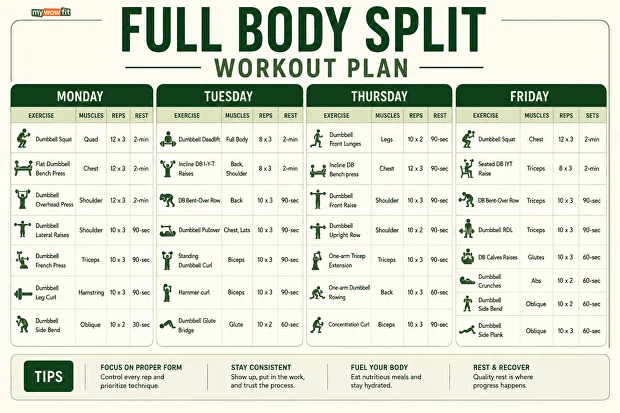
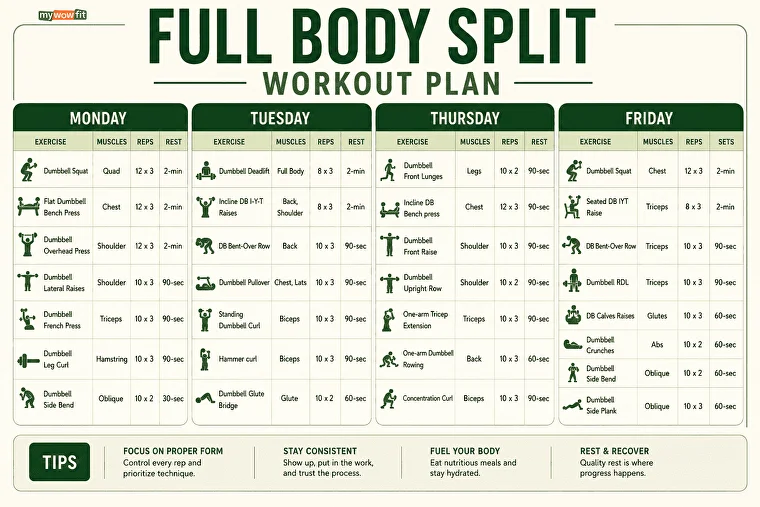
Full Body Split
Full body workouts train all major muscle groups in a single session, usually two to four times per week.
This is one of the best options for beginners because it keeps training simple while allowing muscles to be trained multiple times weekly without excessive volume. Full body routines are also efficient for people with busy schedules since you can still make solid progress training only a few days per week. Another advantage is that beginners recover relatively quickly from moderate full-body sessions, especially compared to very high-volume bodybuilding splits.
The downside is that workouts can become longer and more tiring as strength levels increase. Advanced lifters often need more volume than full-body sessions comfortably allow.
Still, for many people, especially beginners, full-body training is one of the most effective and sustainable starting points.
This is one of the best options for beginners because it keeps training simple while allowing muscles to be trained multiple times weekly without excessive volume. Full body routines are also efficient for people with busy schedules since you can still make solid progress training only a few days per week. Another advantage is that beginners recover relatively quickly from moderate full-body sessions, especially compared to very high-volume bodybuilding splits.
The downside is that workouts can become longer and more tiring as strength levels increase. Advanced lifters often need more volume than full-body sessions comfortably allow.
Still, for many people, especially beginners, full-body training is one of the most effective and sustainable starting points.
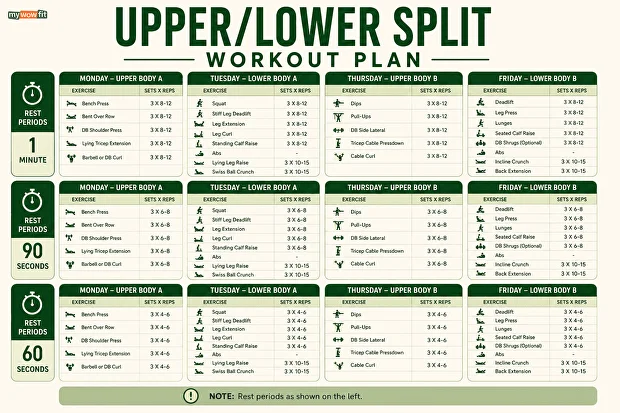
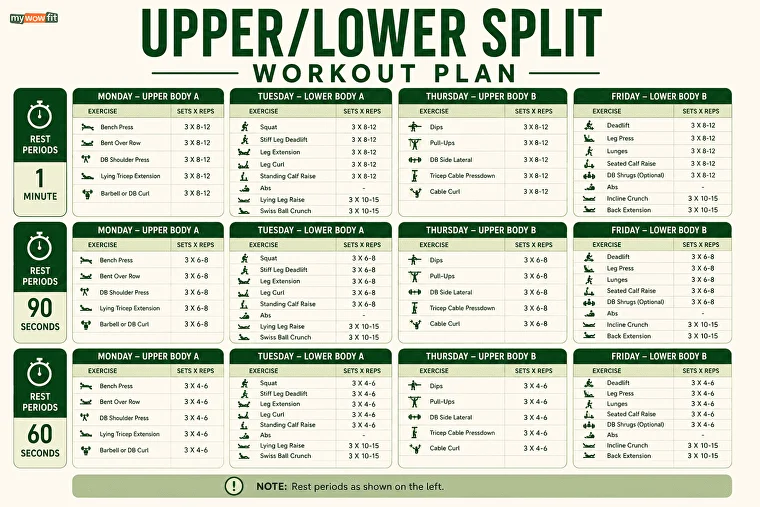
Upper/Lower Split
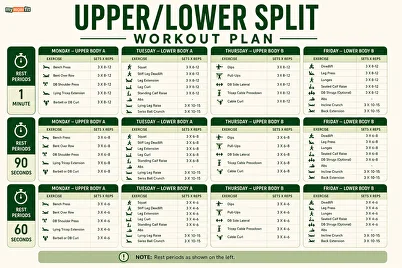
The upper/lower split divides workouts into upper body days and lower body days. This structure balances training volume and recovery very well, which is why it’s one of the most popular intermediate-level splits.
Upper/lower routines allow more focus on individual muscle groups than full-body workouts while still training muscles frequently enough for consistent progress. Many lifters find this split easier to recover from compared to high-volume body-part routines because the workload is distributed more evenly throughout the week.
It’s also highly flexible and can be adapted for muscle growth, strength training or general fitness goals.
Upper/lower routines allow more focus on individual muscle groups than full-body workouts while still training muscles frequently enough for consistent progress. Many lifters find this split easier to recover from compared to high-volume body-part routines because the workload is distributed more evenly throughout the week.
It’s also highly flexible and can be adapted for muscle growth, strength training or general fitness goals.
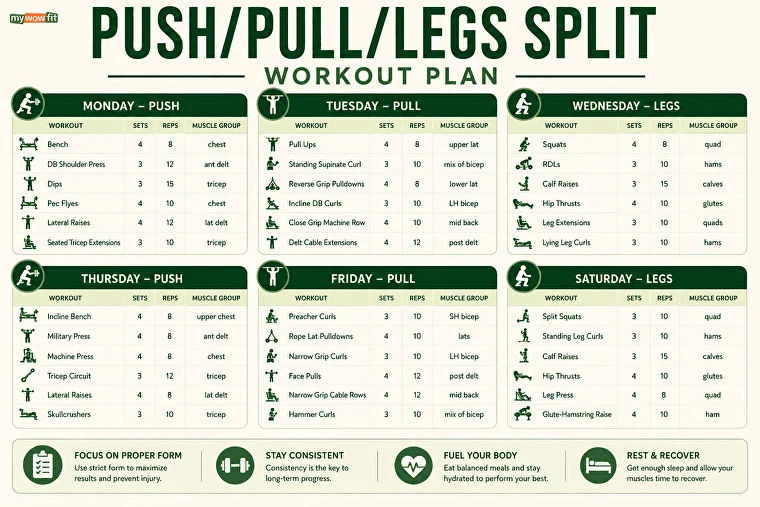
Push/Pull/Legs Split
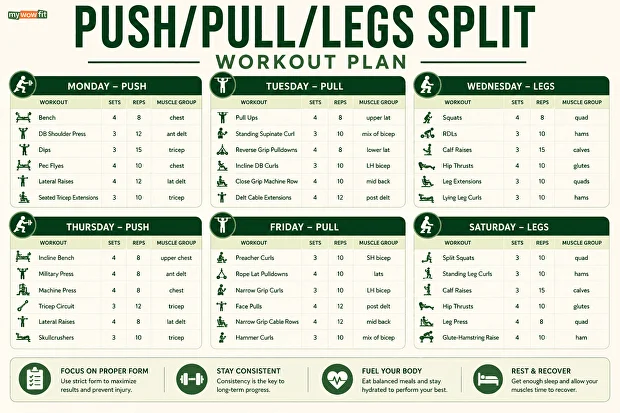
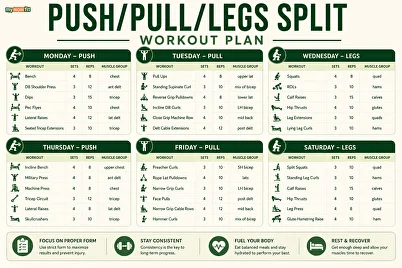
The Push/Pull/Legs split, which is often called PPL, is one of the most popular workout structures today.
It divides training based on movement patterns:
Many say that the Push/Pull/Legs split, felt easier to stay consistent with because the structure felt logical and organized. However, others say that the six-day PPL routines can become difficult to recover from for beginners who underestimate how demanding the volume can be.
That’s why many coaches recommend starting with a three-day version before increasing frequency.
It divides training based on movement patterns:
- Push: chest, shoulders, triceps
- Pull: back, biceps
- Legs: lower body and glutes
Many say that the Push/Pull/Legs split, felt easier to stay consistent with because the structure felt logical and organized. However, others say that the six-day PPL routines can become difficult to recover from for beginners who underestimate how demanding the volume can be.
That’s why many coaches recommend starting with a three-day version before increasing frequency.
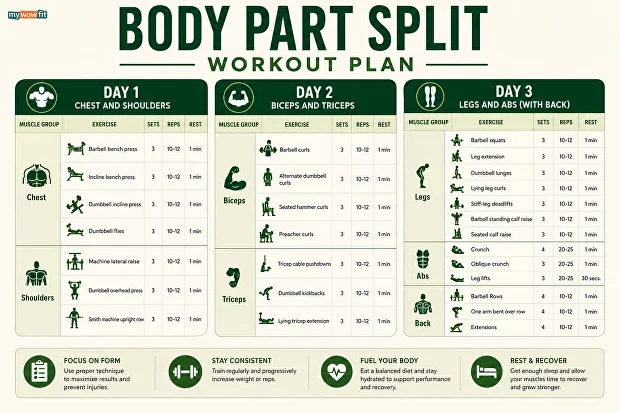
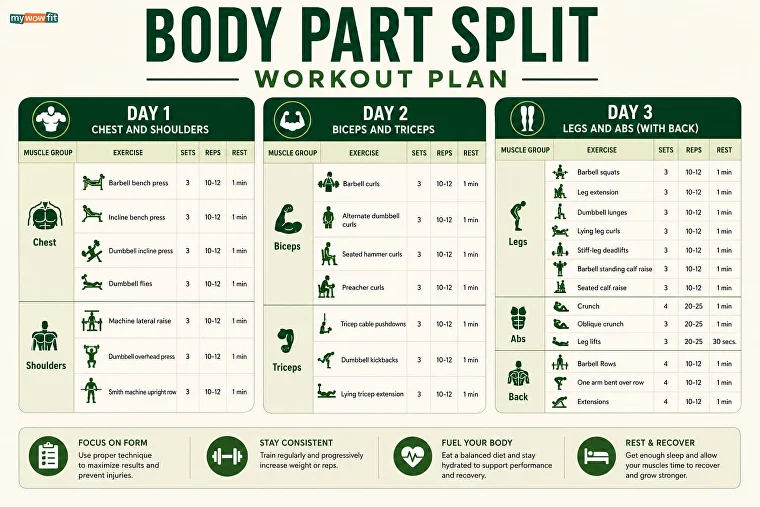
Body Part Split
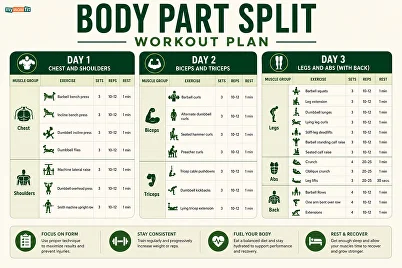
Body part splits also sometimes called “bro splits”, dedicate each workout to a single muscle group.
This approach allows very high training volume for individual muscles and is commonly used in bodybuilding-style training. The advantage is that workouts feel extremely focused and allow lots of exercise variety for specific muscles.
The downside is that muscle groups are usually trained only once weekly, which may not be ideal for beginners or natural lifters who often respond better to slightly higher frequency. Body-part splits also require more weekly training days, making them harder to maintain consistently for people with busy schedules.
This approach allows very high training volume for individual muscles and is commonly used in bodybuilding-style training. The advantage is that workouts feel extremely focused and allow lots of exercise variety for specific muscles.
The downside is that muscle groups are usually trained only once weekly, which may not be ideal for beginners or natural lifters who often respond better to slightly higher frequency. Body-part splits also require more weekly training days, making them harder to maintain consistently for people with busy schedules.
1-on-1 Workouts & Custom Fitness Plans with Online Personal Trainer
★★★★★ 4.8 out of 5 across 600+ reviews
Workout Splits: Building Muscle and Strengthening Bones
One of the biggest advantages of workout splits is that they allow you to train with more focus and structure. By dividing workouts across different muscle groups throughout the week, you can place more attention and energy on specific areas of the body instead of trying to train everything at once.
But the benefits of resistance training go beyond building muscle or improving appearance. Strength training also plays an important role in supporting bone health [3]. When you lift weights or perform resistance exercises, your muscles place stress on the bones they attach to. In response, the body adapts by strengthening bone tissue and increasing bone density over time. This process becomes especially important as we age, since bone density naturally declines and the risk of fractures or osteoporosis increases. That’s one reason why regular strength training is recommended not only for muscle development, but also for long-term health, posture, mobility, and injury prevention.
To optimize bone health through resistance training:
Of course, workouts are only one part of the picture. Recovery, sleep, nutrition and daily habits all play a huge role in muscle growth and bone health as well. Nutrients like protein, calcium, and vitamin D are especially important for supporting recovery and maintaining strong bones over time.
Choosing the right workout split can also make a noticeable difference in progress and recovery. A routine that fits your schedule, recovery ability, and goals will almost always work better than trying to follow an advanced program that feels impossible to maintain consistently. That’s why many people benefit from more personalized guidance. Mywowfit trainers help create workout routines based on individual goals, fitness levels, schedules, and recovery needs, helping people build strength in a way that feels realistic and sustainable instead of overwhelming.
But the benefits of resistance training go beyond building muscle or improving appearance. Strength training also plays an important role in supporting bone health [3]. When you lift weights or perform resistance exercises, your muscles place stress on the bones they attach to. In response, the body adapts by strengthening bone tissue and increasing bone density over time. This process becomes especially important as we age, since bone density naturally declines and the risk of fractures or osteoporosis increases. That’s one reason why regular strength training is recommended not only for muscle development, but also for long-term health, posture, mobility, and injury prevention.
To optimize bone health through resistance training:
- Start with a weight that allows you to maintain good form for 8-12 repetitions. Increase the weight when you can comfortably complete all repetitions with good form
- Consider training 2-4 times a week, focusing on different muscle groups each session
- Incorporate exercises that target key muscle groups to to stimulate bone adaptation by augmenting mechanical strain
- Integrate strength training and endurance exercises for a well-rounded approach to bone health
Of course, workouts are only one part of the picture. Recovery, sleep, nutrition and daily habits all play a huge role in muscle growth and bone health as well. Nutrients like protein, calcium, and vitamin D are especially important for supporting recovery and maintaining strong bones over time.
Choosing the right workout split can also make a noticeable difference in progress and recovery. A routine that fits your schedule, recovery ability, and goals will almost always work better than trying to follow an advanced program that feels impossible to maintain consistently. That’s why many people benefit from more personalized guidance. Mywowfit trainers help create workout routines based on individual goals, fitness levels, schedules, and recovery needs, helping people build strength in a way that feels realistic and sustainable instead of overwhelming.
Guidelines for Volume and Intensity
No matter which split you choose, progress still depends on progressive overload. That simply means gradually giving your body a slightly greater challenge over time so muscles continue adapting.
This can happen through:
But progressive overload does not mean pushing to failure every workout. One of the common misconception online is that harder always equals better. In reality, constantly training at maximum intensity often hurts recovery more than it helps progress.
Most long-term successful lifters focus on consistent progression rather than destroying themselves every session.
One of the most important thing to note, many people tend to underestimate recovery. Sleep, nutrition, hydration, stress management and rest days all directly affect performance and muscle growth.
You cannot out-train poor recovery forever. This becomes especially important with advanced splits or higher training frequency. More workouts only help if your body can actually recover from them.
Sometimes the best thing you can do for progress is take an extra rest day.
This can happen through:
- increasing weight
- adding repetitions
- improving technique
- increasing sets gradually
- slowing movement control and time under tension
But progressive overload does not mean pushing to failure every workout. One of the common misconception online is that harder always equals better. In reality, constantly training at maximum intensity often hurts recovery more than it helps progress.
Most long-term successful lifters focus on consistent progression rather than destroying themselves every session.
One of the most important thing to note, many people tend to underestimate recovery. Sleep, nutrition, hydration, stress management and rest days all directly affect performance and muscle growth.
You cannot out-train poor recovery forever. This becomes especially important with advanced splits or higher training frequency. More workouts only help if your body can actually recover from them.
Sometimes the best thing you can do for progress is take an extra rest day.
Strategies for Implementing Progressive Overload:
Incrementing weight: Gradually enhance the amount of weight on your dumbbells or barbells.
Increasing repetitions: Aim to perform more repetitions during sets and increase the number of sets in your workout.
Extending time under tension: Allocate more time to maintain muscle engagement during exercises.
Altering the workout split: Transitioning to a different split can provide fresh stimuli for your muscles, encouraging progress.
The “best” workout split is rarely the most complicated one. A simple routine followed consistently for months will almost always outperform a perfect routine followed inconsistently for two weeks.
That’s why personalized training can sometimes make a huge difference. Mywowfit trainers help people create workout structures based on their goals, schedules, recovery ability, and fitness levels instead of forcing everyone into the same template. For many people, having a realistic and sustainable plan is what finally makes fitness feel manageable long term.
Increasing repetitions: Aim to perform more repetitions during sets and increase the number of sets in your workout.
Extending time under tension: Allocate more time to maintain muscle engagement during exercises.
Altering the workout split: Transitioning to a different split can provide fresh stimuli for your muscles, encouraging progress.
The “best” workout split is rarely the most complicated one. A simple routine followed consistently for months will almost always outperform a perfect routine followed inconsistently for two weeks.
That’s why personalized training can sometimes make a huge difference. Mywowfit trainers help people create workout structures based on their goals, schedules, recovery ability, and fitness levels instead of forcing everyone into the same template. For many people, having a realistic and sustainable plan is what finally makes fitness feel manageable long term.

Leidon, Functional Trainer, Mywowfit
Leidon, a certified online fitness coach and champion bodybuilder, offers a personalized approach to fitness that caters to all levels. As a multi-award-winning bodybuilder, Leidon possesses a deep understanding of the process required to build a champion physique, ensuring he can guide you towards your goals with expert knowledge.
Leidon is passionate about helping individuals reach their full potential and will be your biggest cheerleader every step of the way. His dedication and supportive nature make him an ideal coach for anyone seeking to achieve their fitness aspirations.
Leidon is passionate about helping individuals reach their full potential and will be your biggest cheerleader every step of the way. His dedication and supportive nature make him an ideal coach for anyone seeking to achieve their fitness aspirations.
Summary
Workout splits are simply tools for organizing training more effectively. They help balance intensity, recovery, and workout structure so your body can continue improving over time without burning out.
Full-body workouts are often ideal for beginners and busy schedules, while upper/lower and push/pull/legs splits can provide more volume and specialization for intermediate or advanced lifters. Body-part splits may work well for experienced athletes focused on hypertrophy, but they also require more recovery and consistency. No split works perfectly for everyone, which is why flexibility matters.
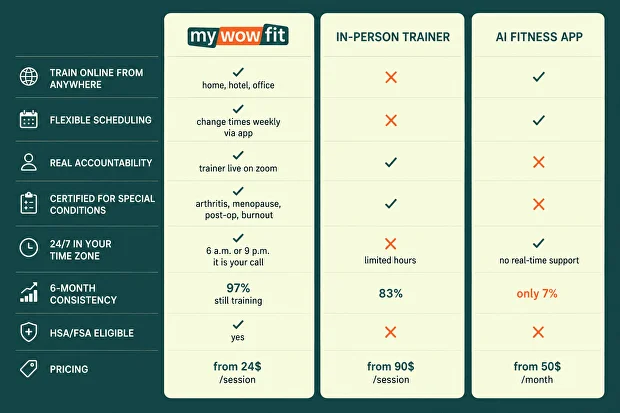
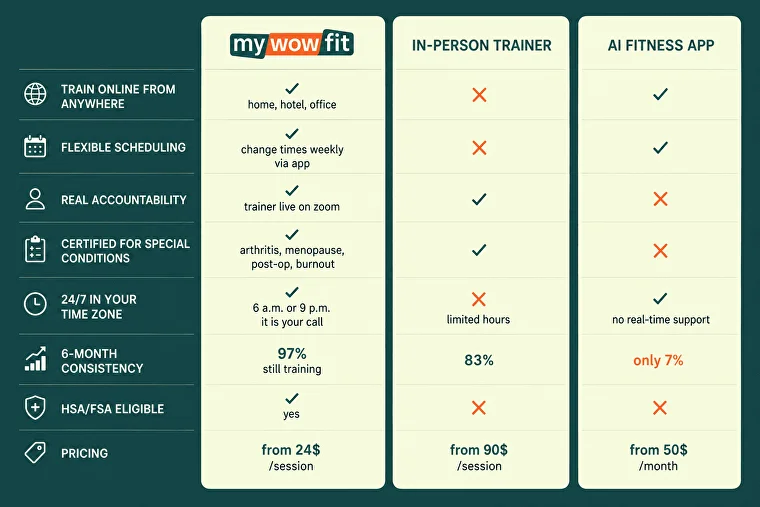
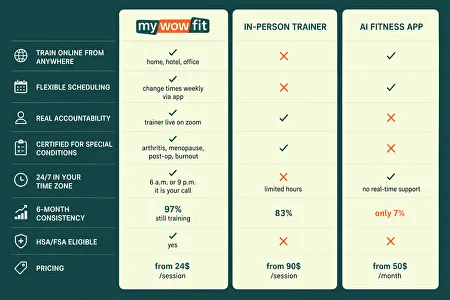
Your goals, schedule, recovery ability, and training experience all influence what kind of routine will work best for you. If unsure, consulting a qualified fitness professional is recommended for personalized program development and guidance. Here is how Mywowfit compares to other options:
Full-body workouts are often ideal for beginners and busy schedules, while upper/lower and push/pull/legs splits can provide more volume and specialization for intermediate or advanced lifters. Body-part splits may work well for experienced athletes focused on hypertrophy, but they also require more recovery and consistency. No split works perfectly for everyone, which is why flexibility matters.
Your goals, schedule, recovery ability, and training experience all influence what kind of routine will work best for you. If unsure, consulting a qualified fitness professional is recommended for personalized program development and guidance. Here is how Mywowfit compares to other options:
1-on-1 Workouts & Custom Fitness Plans with Online Personal Trainer
★★★★★ 4.8 out of 5 across 600+ reviews
Sources:
Mywowfit has strict sourcing policies and relies on primary sources such as medical organizations, governmental agencies, academic institutions, and peer-reviewed scientific journals. We ensure our content is accurate, thorough, and unbiased.
- Harvard Health Publishing. The best exercises for your bones. Harvard Medical School. Available at: Harvard Health Publishing
- National Center for Biotechnology Information. Effects of exercise on bone health. Available at: NCBI PMC Article
- All Subject Journal. Exercise and bone strength research article. Available at: All Subject Journal
Mywowfit has strict sourcing policies and relies on primary sources such as medical organizations, governmental agencies, academic institutions, and peer-reviewed scientific journals. We ensure our content is accurate, thorough, and unbiased.
Responses (2)
Brie
Gonna give a try to the first one!
MAria
So much great info
You may also be interested
Training plans
Meet some of our trainers
Filters
Ryan
🏋 TYPES OF TRAINING
🧍 ORTHOPEDIC FOCUS
📃 CERTIFIED
Stefan
🏋 TYPES OF TRAINING
🧍 ORTHOPEDIC FOCUS
📃 CERTIFIED
Nadene
🏋 TYPES OF TRAINING
🧍 ORTHOPEDIC FOCUS
📃 CERTIFIED

© 2021-2025 Together with Online Fitness Technologies Inc.
All rights reserved
All rights reserved


About
How it Works
Trainers
Pricing
Blog
FAQ
Gift Certificate
Referral Program
Work with Us
Affiliate Program
How it Works
Trainers
Pricing
Blog
FAQ
Gift Certificate
Referral Program
Work with Us
Affiliate Program
Useful Links
Privacy Policy
Terms of Service
Code of Conduct
Disclaimer of Medical Advice
Cancellation, Refund, Referral Policy
Services
Terms of Service
Code of Conduct
Disclaimer of Medical Advice
Cancellation, Refund, Referral Policy
Services
Documentation


Contact Us
Headquarters:
USA, 1111B S Governors Ave #6047 Dover, DE 19904, Online Fitness Technologies INC
USA, 1111B S Governors Ave #6047 Dover, DE 19904, Online Fitness Technologies INC
Locations
Headquarters:
EU and UK: MYWOWFIT OU, Estonia, Harju maakond, Tallinn, Kesklinna linnaosa, Tornimäe tn 3 // 5 // 7, 10145
EU and UK: MYWOWFIT OU, Estonia, Harju maakond, Tallinn, Kesklinna linnaosa, Tornimäe tn 3 // 5 // 7, 10145





5.0
4.9
Share via