
Improve Your Health While Staying Online

In this guide, you’ll learn how no-equipment workouts work, why they’re effective, and how to create a simple routine that fits your lifestyle.
table of contents
Understanding No-Equipment Training Basics
One of the biggest advantages of bodyweight training is accessibility. There are no membership fees, no equipment purchases and no complicated setup required. Your workout space can be a living room or wherever works for you. Another major benefit is convenience. Many people struggle with consistency because exercise feels like a major time commitment. Home workouts eliminate travel time and make it easier to fit movement into your day. Even a 20-minute workout can make a difference when performed regularly.
Bodyweight exercises also help develop functional strength. Instead of training muscles in isolation, many bodyweight movements teach multiple muscle groups to work together. This translates well to everyday activities such as carrying groceries, climbing stairs or lifting children. Many people are surprised by how much body awareness they develop through bodyweight training. Without relying on machines for support, you learn how your body moves, where your weaknesses are and how to improve your balance and coordination.
Perhaps most importantly, bodyweight workouts can be adapted to virtually any fitness level. Beginners can modify exercises to make them easier, while more advanced exercisers can use challenging variations to continue progressing. Just don't forget about safety, make sure you have enough space and listen to your body, don't push yourself do avoid getting injured.
Getting Started: Beginner’s No-Equipment Plan
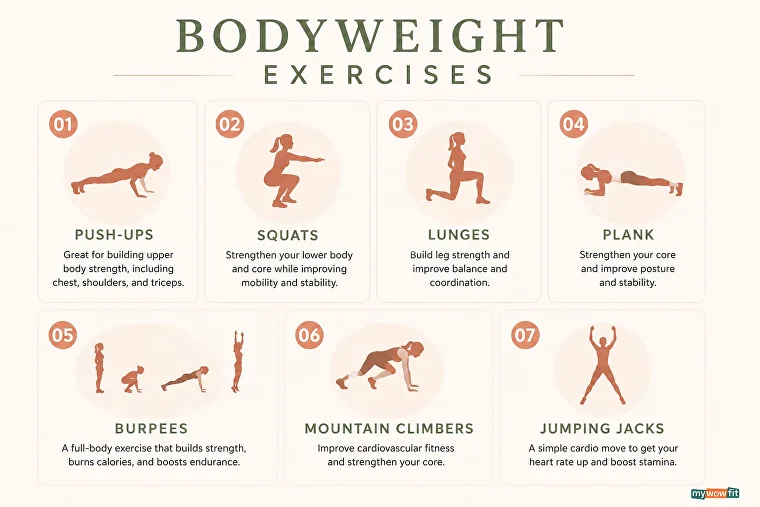
Essential Bodyweight Exercises
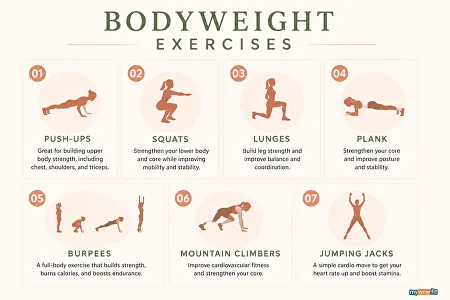
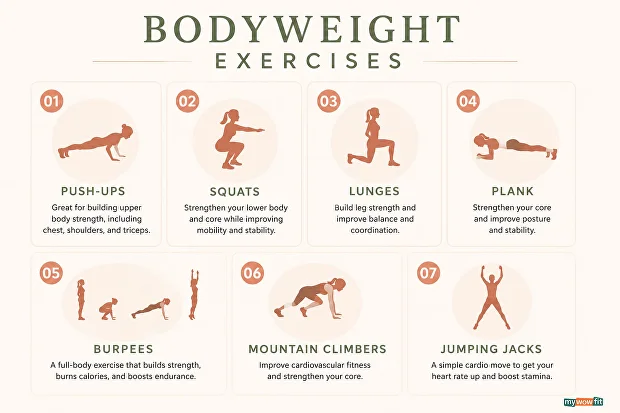
- Push-ups: A classic for building chest, shoulder and tricep strength. Don’t worry if you can’t do a full push up on your toes yet, start on your knees and work your way up.
- Squats: The go-to for leg and glute strength. Get low, keep your back straight and engage your core. If you are having trouble with balance, try using a chair.
- Lunges: Another great leg exercise that also works your glutes and hamstrings. Take big steps and try to keep a 90 degree angle with both legs.
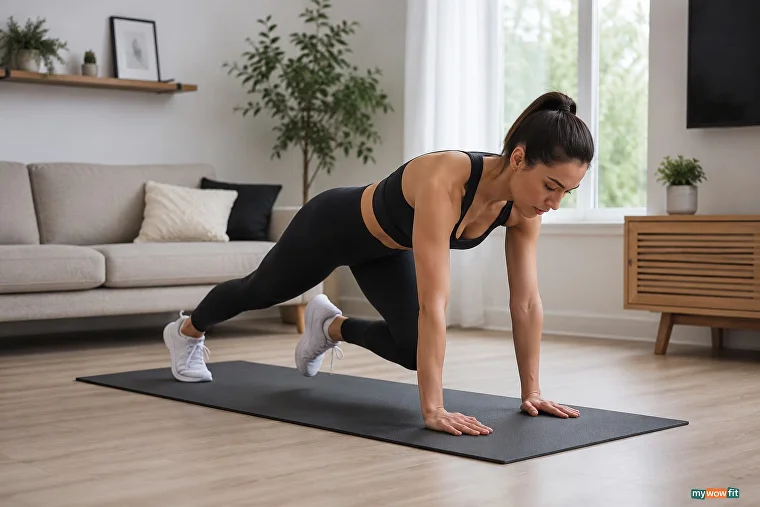
- Plank: The ultimate core exercise. Keep your body in a straight line, engage your core, and try to make it look easy (even if it’s not!). Just make sure you aren’t arching your back.
- Burpees: A full-body, high-intensity exercise that will make you sweat. Try jumping jacks as an easy alternative.
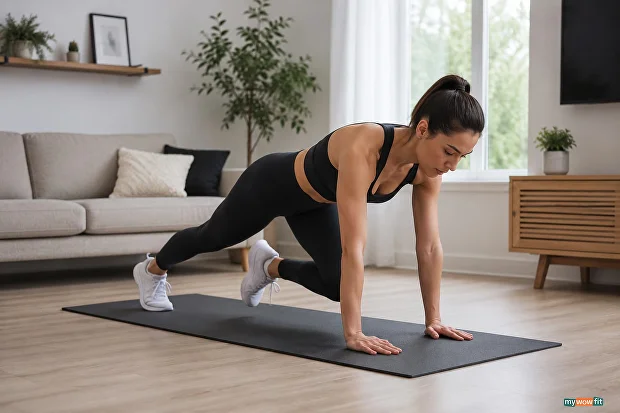
- Mountain Climbers: A great cardio move that works your core. You can start slow and work your way up to full speed.
- Jumping Jacks: A simple but effective cardio move. A good way to get your heart rate up in the comfort of your own home.
Your First Week of Training
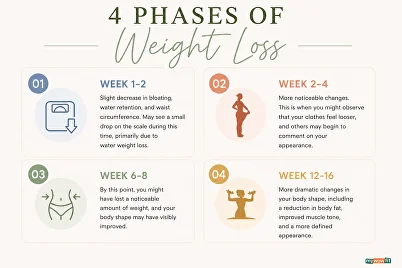
Starting a new fitness routine can feel exciting, but it can also feel overwhelming. Many people make the mistake of trying to do too much too soon. They jump into intense workouts, train every day and quickly burn out. A better approach is to focus on building consistency first.
During your first week, your goal is just to establish the habit of moving regularly. Here’s a sample free at home workout plan without equipment to get you started. It’s a three-day workout schedule, designed to ease you into the world of bodyweight fitness.
1-on-1 Workouts & Custom Fitness Plans with Online Personal Trainer
Progressive 30-Day Program
A simple 30-day approach can help you build strength, endurance, and confidence without feeling overwhelmed.
Week 1: Focus on Form
The first week is all about learning proper movement patterns. Rather than worrying about how many repetitions you can complete, focus on performing each exercise correctly. Move slowly. Pay attention to your posture. Learn how each exercise should feel. Building a strong foundation now will make future progress much easier.
Week 2: Build Endurance
Once you’re comfortable with the exercises, start increasing the number of repetitions or extending your work intervals. You might move from 30-second exercise intervals to 45-second intervals, or add an extra round to your circuit. The goal is to improve your work capacity while maintaining good form.
Week 3: Increase Intensity
Now it’s time to challenge yourself a little more. This could mean adding more repetitions, shortening rest periods or trying slightly more advanced exercise variations. For example, you might progress from knee push-ups to incline push-ups or from standard squats to pause squats. Small changes can create a significant increase in difficulty.
Week 4: Put Everything Together
The final week combines everything you’ve learned. Your workouts should feel more challenging than they did at the beginning of the month, but they should still be manageable. By this stage, you’ll likely notice improvements in strength, endurance, coordination, and confidence. Many people also find that daily activities feel easier because they’ve developed better overall fitness.
The most important lesson from any 30-day program isn’t what happens during the month itself. It’s learning that consistent effort produces results.
Muscle Building Without Weights
The key here is progressive overload. One way to do this is by increasing repetitions. If you can comfortably perform 10 squats, work toward 15 or 20. Another strategy is adding more sets, increasing the total amount of work your muscles perform. You can also slow down your movements. Lowering yourself slowly during a squat or push-up increases time under tension, which can stimulate muscle growth even without additional resistance. Reducing rest periods between exercises is another effective strategy. This increases workout intensity and challenges both muscular and cardiovascular endurance.
As you become stronger, you can progress to more advanced exercise variations. Single-leg squats, decline push-ups, jump lunges and explosive movements all increase the challenge without requiring equipment.
Of course, exercise is only part of the equation. Nutrition plays a major role in muscle development. Your body needs adequate protein to repair and build muscle tissue, along with enough calories to support recovery. This doesn’t mean you need a complicated diet. Focus on eating balanced meals that include lean protein sources, fruits, vegetables, whole grains and healthy fats. Combined with consistent training, these habits can support impressive results over time. Many people underestimate what can be achieved through bodyweight training alone. While you may not become a competitive bodybuilder without weights, you can absolutely build noticeable strength, muscle definition, and athleticism from home.
The combination of progressive training, good nutrition and patience is often more effective than constantly searching for the latest fitness trend. By the end of your first month, you’ll likely discover that your body is capable of far more than you initially believed.[2]
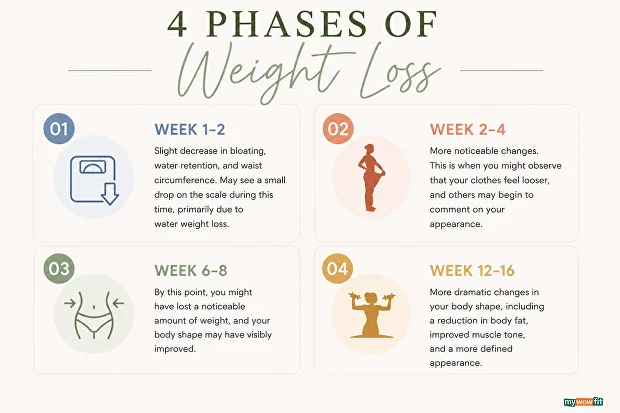
Weight Loss-Focused Program
HIIT workouts are popular because they can be completed in a relatively short amount of time while still challenging both your muscles and cardiovascular system. They can also be easily modified based on your fitness level. Beginners can work at a slower pace and choose lower-impact movements, while more advanced exercisers can increase intensity and reduce rest periods. However, it’s important to remember that weight loss isn’t about making every workout as difficult as possible. Consistency always beats occasional extreme effort. A realistic workout schedule that you can maintain for months will produce far better results than an aggressive plan that leaves you exhausted after two weeks.
Nutrition also plays a major role. Exercise helps create the conditions for weight loss, but healthy eating habits support the process. Focus on balanced meals that include protein, fiber-rich foods, healthy fats and plenty of fruits and vegetables. Small improvements made consistently often lead to bigger results than drastic short-term diets.
Common Mistakes and Solutions
One of the biggest problems is poor exercise form. Many people focus on doing more repetitions rather than performing each movement correctly. Poor technique not only reduces the effectiveness of the exercise but can also increase the risk of injury. Taking the time to learn proper form is one of the best investments you can make in your fitness journey. Another common mistake is doing the same routine for too long. While consistency is important, your body adapts quickly. If your workouts never change, progress often slows down. Gradually increasing difficulty, trying new exercise variations or adjusting workout intensity can help keep results coming.
Recovery is another area that many people overlook. Some assume that training harder and more often automatically leads to better results. In reality, your body needs time to recover and adapt. Rest days, quality sleep and proper nutrition are all essential parts of any successful fitness plan.
Perhaps the biggest mistake of all is expecting immediate results. Fitness is a long-term process. Progress may feel slow at times, but small improvements add up quickly when you stay consistent.
How to Track Your Progress
Progress photos can be surprisingly effective. Changes often happen gradually, making it difficult to notice from day to day. Looking back at photos taken a few weeks apart can provide a much clearer picture of your results. Body measurements are another useful tool. Tracking your waist, hips, arms, chest or thighs can reveal changes that may not appear on the scale. This is especially helpful if you’re building muscle while losing body fat.
Performance improvements are also worth celebrating. Maybe you can now perform more push-ups than when you started. Maybe your plank time has doubled or your workouts feel easier than they did a month ago. These are all signs that your fitness is improving. Pay attention to how you feel outside of workouts as well. Increased energy, better sleep, improved mood and greater confidence are valuable indicators of progress that often appear before major physical changes.
Setting realistic goals can help maintain motivation. Rather than focusing only on a number on the scale, consider goals such as completing a certain number of workouts each week, improving exercise technique or increasing your strength and endurance.
Remember that progress is rarely perfectly linear. Some weeks will feel better than others. What matters most is continuing to show up.
1-on-1 Workouts & Custom Fitness Plans with Online Personal Trainer
Conclusion
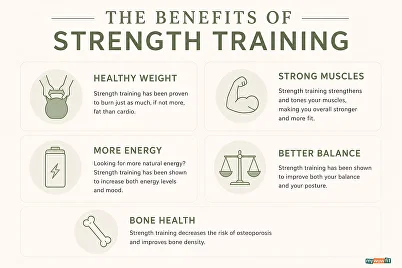
Getting fit doesn’t require a gym membership, expensive equipment or hours of free time. With a well-structured bodyweight training program, you can build strength, improve endurance, lose weight and develop healthier habits from the comfort of your own home. The key is to focus on the fundamentals. Learn proper movement patterns, build consistency before intensity and allow your body enough time to recover. Small actions repeated regularly will always outperform few super intense workouts.
If you’re looking for additional structure, guidance or accountability, working with a qualified trainer can help you stay motivated and make faster progress. Mywowfit offers personalized workout plans and one-on-one coaching designed to fit your goals, schedule, and fitness level. Whether you’re just starting out or looking to take your home workouts to the next level, having expert support can make the journey easier and more enjoyable.
The most important step, however, is the first one. Start where you are, use what you have, and keep moving forward. Your living room may be all the gym you need.
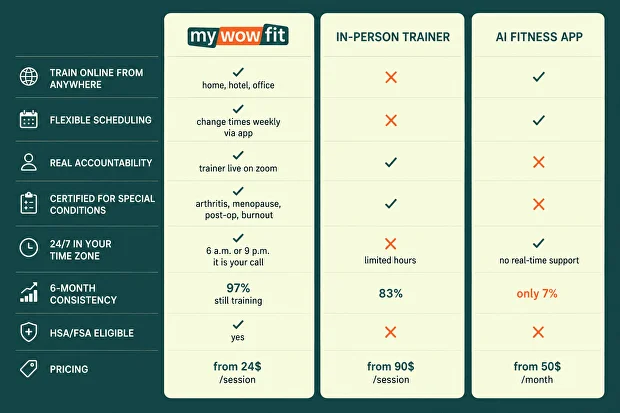
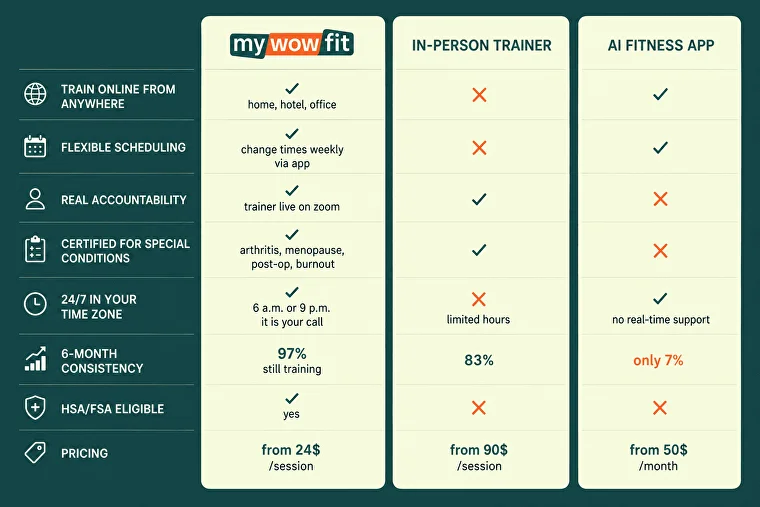
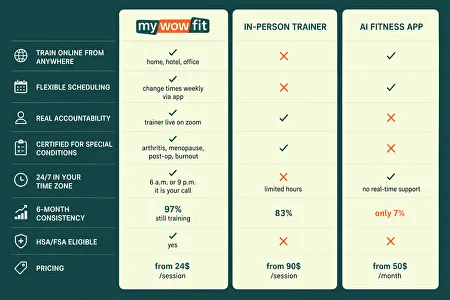
Here’s how working out on your own compares to other options :
Key Takeaways
Bodyweight is Resistance: Use your own body weight as the resistance for strength training.
Form is Non-Negotiable: Focus on proper technique above all else.
Gradual Intensity: Implement progressive overload to keep challenging yourself and to avoid a plateau.
HIIT for Fat Loss: Use HIIT techniques to burn more calories and shed weight.
Recovery is Crucial: Always schedule in rest periods and workout recovery to give your body a chance to recuperate.
Consistency + Fun = Success: Stay consistent and enjoy the process, and you will see the changes you’re after.
FAQ
Can I build muscle at home without equipment? Yes! While lifting weights is a popular way to build muscle, you can build muscle at home using your own body weight. Focus on increasing the reps and sets, and progress to harder variations over time.
What is the best no equipment workout? There isn’t a single “best” free at home workout plan without equipment, as what works best depends on individual goals. However, a great no-equipment workout will focus on compound exercises that work multiple muscle groups, like squats, push-ups, lunges, planks and burpees. Make sure to also include rest and recovery periods.
Responses (9)
National Library of Medicine. National Center for Biotechnology Information (PudMed):
- How much protein can the body use in a single meal for muscle-building? Implications for daily protein distribution - pubmed.ncbi.nlm.nih.gov
- Can high-intensity interval training improve physical and mental health outcomes? A meta-review of 33 systematic reviews across the lifespan - pubmed.ncbi.nlm.nih.gov
Photo:
You may also be interested
Meet some of our trainers
" I'm committed to bringing aboard top-tier trainers to provide the best personal training service in the world. I will help you find your perfect match."

All rights reserved


How it Works
Trainers
Pricing
Blog
FAQ
Gift Certificate
Referral Program
Work with Us
Affiliate Program
Terms of Service
Code of Conduct
Disclaimer of Medical Advice
Cancellation, Refund, Referral Policy
Services


USA, 1111B S Governors Ave #6047 Dover, DE 19904, Online Fitness Technologies INC
EU and UK: MYWOWFIT OU, Estonia, Harju maakond, Tallinn, Kesklinna linnaosa, Tornimäe tn 3 // 5 // 7, 10145





Share via